

Comfortable, Affirming, Online
Autism & ADHD Assessments for Adults

Does this sound like you?…
All your life, you’ve struggled to fit in and never quite feel you belong
You have to put in extra effort to seem “normal” and meet expectations
You find everyday situations overwhelming, while others are unfazed
Your socials are showing you more neurodivergent content—and it’s oddly relatable
You have a running list of your Autistic or ADHD traits, or are “peer reviewed,” but you want a professional to confirm if it adds up
You already self-identify as ADHD or Autistic, and want to feel more confident about that, need a formal diagnosis for accommodations, or need guidance about how to meet your neurodivergent needs
You’re not alone! Many late-diagnosed Autistic and ADHD people have been through these experiences—including me. And let me tell you, there is a whole world of possibilities once you discover your neurotype! Let’s see what we can do for you.

My qualifications
PhD-level Licensed Mental Health Counselor (LMHC)
Diagnostic Privilege -qualified to diagnose Autism, ADHD, and anything in the DSM in all my states of licensure
Trained in affirming assessment for Autism and ADHD by clinicians who share those neurotypes
AuDHD, late-identified - my lived experience helps me recognize “neurokin,” including those who’ve gone undiagnosed
Active in Autistic and ADHD communities and dedicated to learning from ND-identified and affirming sources
Credential: Best Practices in Autism Assessment for Clinicians, issued by The Chicago School, verified on Credly. View verified credential on Credly
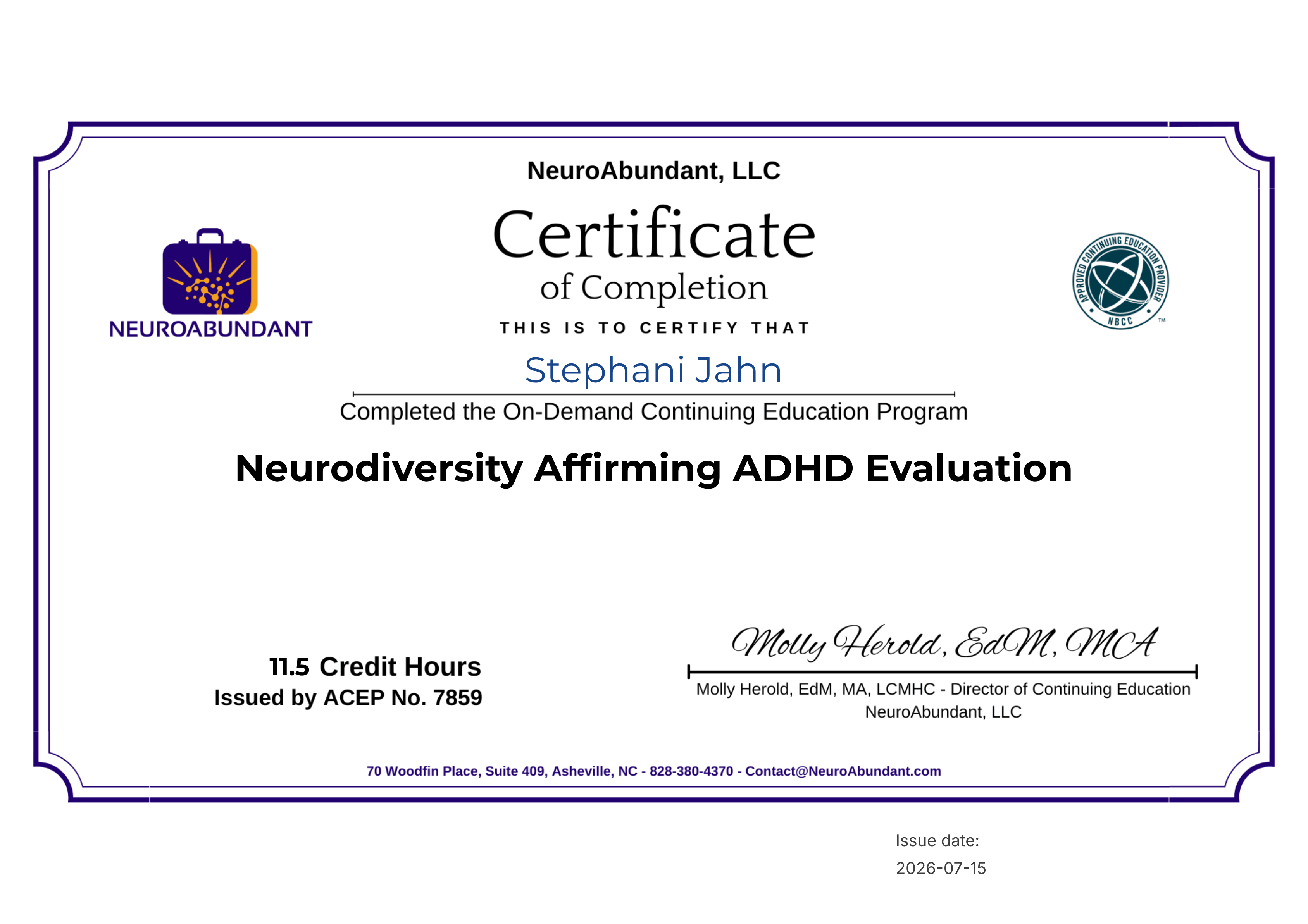
Credential: Neurodiversity Affirming ADHD Evaluation, issued by Neuro Abundant, verified on Certifier. View verified credential on Certifier
My approach
- Collaborative - I see you as the expert on your lived experience, while I’m the one who confirms how that aligns with diagnostic criteria and community knowledge.
- Compassionate - My clients express they’ve felt understood in a rare and positive way in our assessment process. They leave with an uplifting sense of knowing themselves better, and having new tools to fit their needs.
- Transparent - I avoid making you wait for a “big reveal” about the end of the assessment. I’ll keep you informed on what seems to be showing up as we go along. I love to answer questions about the process.
- Accommodating - Type in the chat, turn on live captions, stim freely, turn off your video, and share input via email—ask for what you need at any time!
- Holistic - I account for factors like masking and influences of your race, culture, and gender in your life. This helps avoid missing diagnoses for people who get overlooked by traditional approaches.

Having a provider you can be comfortable with matters. Learn more about my identities and values here.
I believe that your self-understanding
—not just a professional’s opinion—
is what will make a real difference in your life.
Affirming Autism Assessment for Adults
I’m trained in assessment methods that account for presentations that are traditionally missed, including those who are:
high-masking
low support needs (sometimes called “level 1/high-functioning”)
well-accommodated/healthy (traditional approaches focus on signs of Autistic distress, overlooking uniquely Autistic indicators of wellness)
PDAers, AuDHDers, extraverts, women, and others who contradict stereotypes

Information we’ll collect in your Autism assessment
-
Intake interview
ACIA (Autism Clinical Interview for Adults), and/or
MIGDAS-2, the Monteiro Interview Guidelines for Diagnosing the Autism Spectrum, second edition
Unlike the common ADOS-2’s supposedly “gold standard” process, you won’t be subjected to childish, confusing activities. These interviews can actually be kind of enjoyable, because we’ll embrace your special interests, sensory needs, and natural interaction style.
-
These include
ACIA’s Pre-Interview Questionnaire
CAT-Q, the Camouflaging Autistic Traits Questionnaire
RAADS-R, the Ritvo Autism Asperger Diagnostic Scale-Revised
AQ, the Autism Spectrum Quotient
CATI, the Comprehensive Autistic Trait Inventory
SPM-2, the Sensory Profile Measure, 2nd edition, plus a sensory checklist to clarify your profile
Plus measures of emotion regulation and interoception (related to recognizing bodily needs and emotions, associated with autism)
-
Collateral - YOU choose whether to involve people like your partner/s, friends, coworkers, family members, etc.
Records - You can also share things like childhood records or your own self-observations while questioning your neurotype (yes, I know it’s 20 pages long—and that’s relevant!)

Affirming ADHD Assessment for Adults
I’m trained in assessment methods that account for presentations that are traditionally missed, including ADHD adults in general, especially those who are:
high-masking or have compensatory strategies/supports
have hyperactivity that is mental/internalized/suppressed
experience hyperfocus
meet traditional measures of success (e.g., academics, career)
told they are “just lazy” or “need to try harder/smarter”
AuDHDers, introverts, women, and others who contradict stereotypes
Information we’ll collect in your ADHD assessment
-
Intake interview
DIVA-5 interview (the Diagnostic Interview for ADHD in adults)
This is a semi-structured interview, and I facilitate it in an affirming way.
If memory is difficult for you (as is common for ADHDers), we can work together to uncover your story.
-
These include
AAMM, the Adult ADHD Masking Measure
BDEFS-LF, the Barkley Deficits of Executive Functioning Scale-Long Form
ASRS, the Adult Self-Report Scale v. 1.1
ESQ-R, the Executive Skills Questionnaire-Revised
WURS-25, the Wender-Utah Rating Scale-25
SPM-2, the Sensory Profile Measure, 2nd edition, plus a sensory checklist to clarify your profile
Plus measures of emotion regulation and interoception (related to recognizing bodily needs and emotions, associated with ADHD)
-
Collateral - YOU choose whether to involve people like your partner/s, friends, coworkers, family members, etc.
Records - You can also share things like childhood records or your own self-observations while questioning your neurotype (or your intention to write it down or the fact that you misplaced it… that’s relevant info, too)
Process summary
All assessments take place fully online.
Doing an assessment with me is a thorough, collaborative process filled with education and support from the initial consultation, through interviewing, to the final report.
We’ll work together over the course of a month to allow you time to process what we’re discovering. I work with only one assessment client at a time to support a deeper focus.
Your report will include context to help you and others understand you best, like advocacy and education about how to support your unique neurodivergent traits.
The report includes clear differentials (“why it’s this not that”) to help ensure your diagnoses don’t get “overshadowed” or dismissed when you might share your report with others, or imposter syndrome creeps back in.
Click to expand
-
Affirming diagnostic interviews — ACIA or MIGDAS-2 for Autism; DIVA-5 for ADHD
Full battery of validated self-report measures
Comprehensive diagnostic report with psychoeducation tailored to your specific presentation
Sensory profile report
Diagnosis confirmation letter
Recommended accommodations for work or school
Tailored resource list
Neurodivergent Insights digital workbooks/toolkits to suit your needs
Sensory strategies sessions (2× 50 minutes)
Follow-up appointment (50 minutes) to discuss your results and next steps
Access to your personal client dashboard throughout the process
Assessment fees
I offer a certain number of reduced-rate slots each year — typically 4 at the Reduced Rate and 2 at the Access Rate. When those slots are filled I maintain a waitlist.
Please read the descriptions below to find which best describes your situation. I leave it to you to determine which rate matches your situation. Generally, the right rate is one that may require planning and feel like a stretch, but won’t impede meeting your basic needs.
Every client gets the same quality of process and documentation, regardless of which rate they pay. The sliding scale structure below is how I make that possible for more people.
Sliding scale tiers
Click to expand
-
For those with stable income and meaningful financial cushion, such as savings, assets, property, or reliable access to family financial resources.
This rate reflects the full value of the process—the time, expertise, and care that goes into an assessment like this, as well as the benefits it brings in your life. Those who pay at this level help me continue offering reduced rates to others. -
For those with steady income but limited financial flexibility, meaning you can cover your needs but without much cushion. You may be early in your career, carrying significant debt, supporting others, or managing necessary expenses that leave little room for extras.
This rate is available to all Black and Indigenous people, including those whose finances fit the standard rate description, in response to the effects of systemic racism on your access to wealth and healthcare. -
For those whose financial situation is less stable or predictable. Your income may be inconsistent, limited, or dependent on others, and discretionary spending of any kind requires real consideration.
This rate is available to Black and Indigenous people who are facing additional financial and systemic challenges.If even the Access Rate feels out of reach, I don't want you to go without options. Reach out and I'll do my best to help you find a path forward, whether with me or elsewhere.
Note: Race is explicit in these descriptions because vague language prevents people from using options that are meant for them. The diagnostic gap for Black and Indigenous neurodivergent people is considerable, and it amplifies the other injustices upheld by racism, including economic disadvantages.
Assessment Fees Sliding Scale
Open the "sliding scale tiers" section above to determine your rate.
| ADHD | $2,400 | $1,800 | $1,200 |
| Autism | $2,750 | $2,050 | $1,375 |
| Autism & ADHD | $3,400 | $2,550 | $1,700 |
Additional services
Assessment add-ons:
Additional follow-up consultation
Helpful for fine-tuning strategies, getting support for identity reflections)
$175 for 50 minutes
Additional interviewing/document review
For complex cases or assessing additional diagnose
$35/quarter-hour
Stand-alone services:
“Second opinion” review
Review of prior assessment report, with meeting to discuss impressions and recommendations.
$175/50 minutes, plus document review at $35/quarter-hour
“Questioning” consultation (non-diagnostic)
For those who are unsure about seeking formal diagnosis, or want a less extensive exploration of their neurotype, such as a screening, discussion of considerations for formalizing a diagnosis, or exploration of self-identification with a clinician.
30-90 minutes (prorated based on rate of $175/50 minutes)Strengths & Traits Inventory (STI)
For those who are self-identified or formally diagnosed, this is a chance to take a brief but deep dive into your neurodivergent identity. Using the comprehensive Strengths and Traits Inventory, we will explore your strengths and struggles, and identify key strategies for your wellbeing goals.
2× 90 minute appointments
Standard Rate $750 | Reduced Rate $560 | Access Rate $375 (see sliding scale details above to identify your rate)
Payment & insurance
A $250 deposit is required to secure appointments and receive assessment forms.
The remainder of the fee is requested to be paid in two installments, split evenly between the dates of the first and final appointments.
Alternative (short-term) payment plans may be arranged by request.
All services are self-pay. I am not in-network with any insurance plans.
At your request, I will provide superbills that you can submit to insurance for out-of-network (OON) coverage, depending on your plan.
I can recommend services that will file OON claims for you for a small fee. They can also check your coverage and fight claim denials. (No financial conflict to disclose.)
Not all insurance plans will cover diagnostic assessments, and some may cover only certain parts of it. Confirm coverage with your insurance provider in advance; expand the next section for what to ask about.
-
The CPT codes to check with your insurance are:
1 unit of 96130 Assessment: psychological testing, evaluation by qualified healthcare provider, first hour
2 units of 96131 Assessment: psychological testing, evaluation by qualified healthcare provider, each additional hour
1 unit of 96136 Assessment: psychological test administration and scoring by qualified healthcare provider, first 30 minutes
2 units of 96137 Assessment: psychological test administration and scoring by qualified healthcare provider, each additional 30 minutes
2 units of 90834 or 90847 Individual Psychotherapy, 38-52 minutes or 53-60 minutes
Be sure to mention that it's telehealth, with the Place of Service (POS) code: 10 (if you log into assessment calls from home) or 02 (if you log in from somewhere else). Specifically ask if there are telehealth exclusions. Some insurers don't mention that and it can cause an issue later.
Important notes
It is your responsibility to verify that the results of this assessment will meet your needs, and I am happy to do what I can to help you clarify that. These are some factors you might consider:
My assessments are NOT “neuropsychological testing,” which may be required by some entities.
I am a Licensed Mental Health Counselor, NOT a Psychologist. However, like Psychologists, I am a PhD-level provider (rather than Master’s-level), which can help meet some institutional requirements.
My reports are deeply based in affirming frameworks, while also using language that is intended to meet the requirements of most employers and higher education settings for getting accommodations in the US.
Currently, my assessments are NOT intended to support seeking SSDI.
I can NOT prescribe medication. My reports bridge neuro-affirming perspectives into medical terms to help support your healthcare, and I can provide information to prescribing providers at your request and with your written consent.
I do not provide ESA letters at this time, although I gladly provide documentation for other accommodations.
To learn more
Visit my page about things to consider when deciding to seek a formal diagnosis, or reach out for a free brief consultation with me.